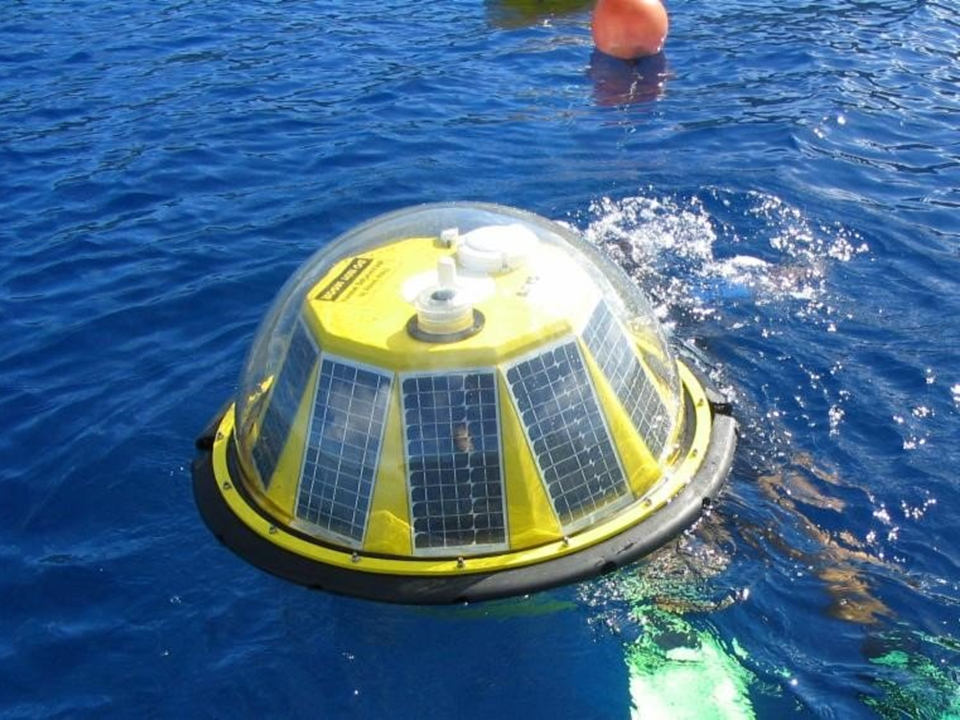



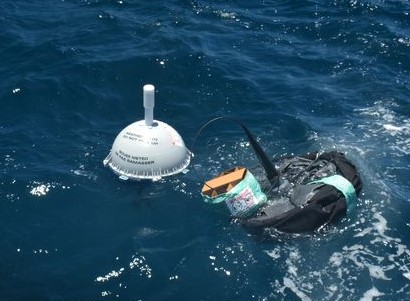
Drifting buoys are generally attached to some form of drogue or sea-anchor, are easy to deploy, are relatively inexpensive to operate and reliably measure the atmosphere and ocean surface conditions, for an average of 18 months. Drifting buoys have a long history of use in oceanography, principally for the measurement of currents. There have also been many types of drifting buoys used for meteorological purposes since the First GARP Global Experiment (FGGE) in the 1970s.
The DBCP has been working for decades to design standardised drifting buoys to suit observational requirements for meteorological and oceanographic applications. Buoys that track surface currents in this way are called Lagrangian drifters and track ocean currents at the depth corresponding to the length of their drogue whilst collecting surface and subsurface measurements.
Lagrangian drifters were first designed and deployed in the world oceans in the context of the Surface Velocity Program (SVP) of the World Ocean Circulation Experiment (WOCE) and the Tropical Ocean and Global Atmosphere Program (TOGA), which became the Global Drifter Program (GDP). These SVP drifters were standardized in 1991, with small spherical hull and floats, and large Holey-Sock drogue centred at 15 meters below the surface. In 1993, drifters with barometer ports, called SVPB drifters, were tested in the high seas and proven reliable.
The Lagrangian Barometer Drifter, designed by the GDP, is now commercially available at low cost, and meets both oceanographic requirements (research: measurements of sea surface currents and sea temperature) and meteorological requirements (operational: sea surface temperature and air pressure). The DBCP has now mostly standardised on the use of SVP and SVP buoys, and their variants for the high seas.